
Mushroom Grow Bags: The Complete Guide to Choosing the Right Spawn Bags
Your substrate is only as good as your bag. Every contamination event, every failed colonization, every batch that doesn't fruit the way it should — a surprising number of these failures trace back to the grow bag itself. Wrong filter size. Wrong thickness. Wrong polypropylene grade. Using a bag that wasn't designed for your sterilization method.
This guide covers everything you need to know about mushroom grow bags so you can stop guessing and start growing consistently.
What Are Mushroom Grow Bags?
Mushroom grow bags — also called spawn bags, substrate bags, or mycology bags — are polypropylene (PP) bags used to contain and sterilize substrate for mushroom cultivation. They're the standard vessel for grain spawn, sawdust blocks, bulk substrate, and all-in-one grow setups at every scale from hobbyist to commercial.
Unlike regular plastic bags, proper mushroom grow bags are made from food-grade polypropylene that can withstand the temperatures required for pressure sterilization (240–250°F / 115–121°C) without melting, warping, or off-gassing. They incorporate a filter patch — a small panel of microporous material — that allows gas exchange while blocking airborne contaminants.
The Most Important Variable: Filter Patch Micron Rating
If there's one specification that matters more than any other, it's the micron rating of the filter patch. This tiny number determines what gets in and what stays out — and getting it wrong means contamination.
0.2 Micron Filter Bags
The most restrictive filter. Blocks virtually everything including most bacteria. Used for applications requiring near-sterile conditions throughout colonization — highly contamination-prone species or environments, medical mycology research, and biomedical applications. The trade-off: restricted airflow can slow colonization and cause CO₂ buildup if the colonization environment isn't well-managed.
Best for: Difficult species, highly contaminated environments, research applications.
0.2–0.5 Micron Filter Bags
The range where most serious cultivators operate. The 0.5 micron rating is the most popular sweet spot in commercial mushroom production — it blocks mold spores and most contaminant organisms while allowing adequate CO₂/O₂ exchange to support healthy mycelium growth. This is the filter size used in most professional-scale spawn operations.
Best for: Grain spawn, master's mix blocks, hardwood sawdust blocks, gourmet and medicinal species.
0.5 Micron Filter Bags
The commercial standard. Provides excellent contamination resistance while allowing the gas exchange that mycelium needs to colonize efficiently. At Dragon Chewer, our 0.5 micron autoclave bags are used by cultivators scaling from home operations to commercial production runs.
1–5 Micron Filter Bags
More breathable, less restrictive. Used for fast-colonizing species in clean environments where airflow matters more than maximum contamination defense. Also suitable for fruiting applications where the bag remains closed during colonization but needs higher gas exchange.
Best for: Oyster mushrooms, fast colonizers, well-controlled clean rooms.
Injection Port Bags vs. Filter Patch-Only Bags
This is the other major fork in the road when choosing grow bags.
Filter Patch Bags (No Injection Port)
The standard configuration. After filling and sealing, inoculation is done by injecting through the polypropylene bag itself (self-healing PP allows needle insertion without permanent puncture) or by opening the bag in a still air box (SAB) or laminar flow hood. These bags are simpler, cheaper, and fully adequate for grain-to-grain transfers and most inoculation methods.
Injection Port Bags
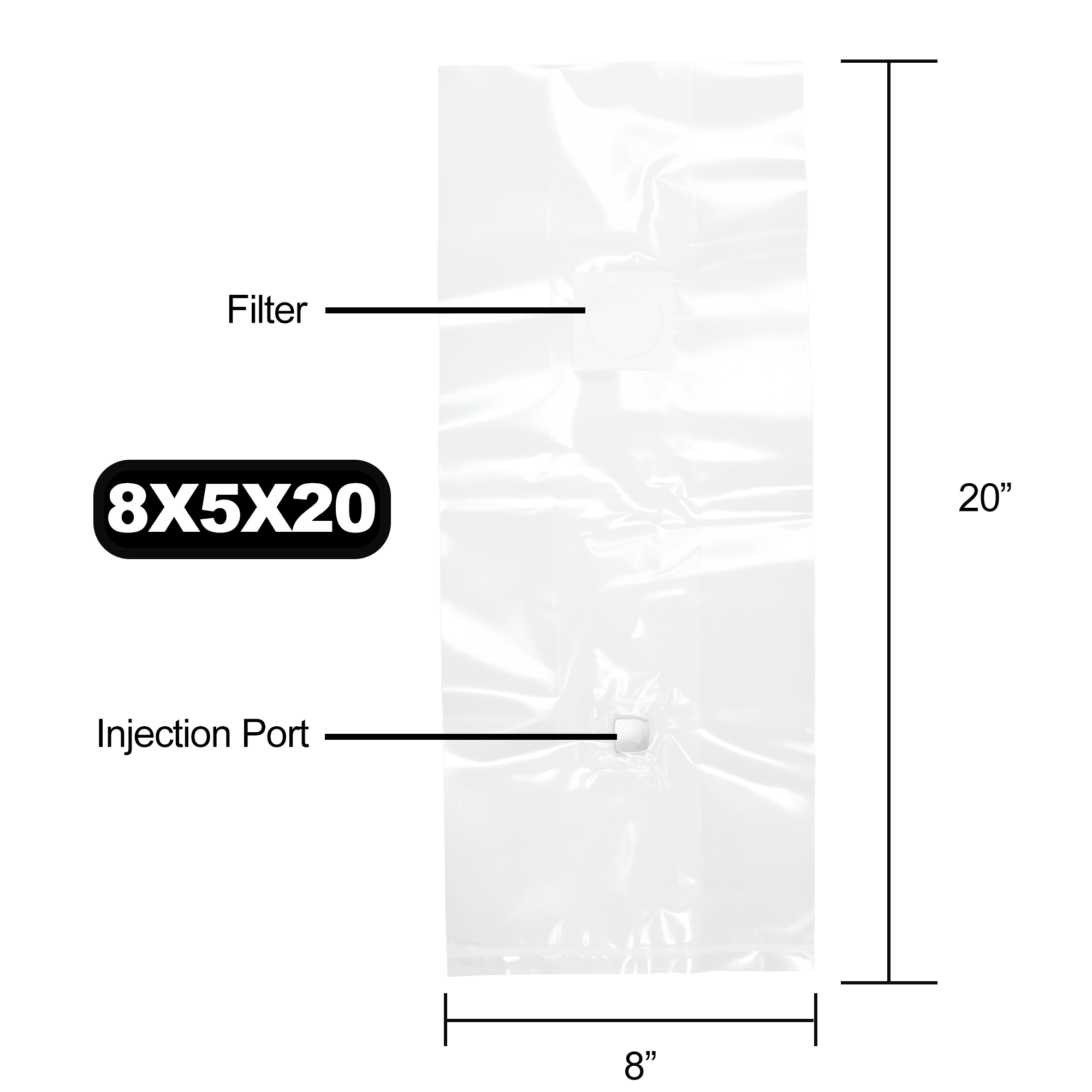
These bags have a self-healing silicone or rubber port pre-installed — a designated injection point that allows liquid culture (LC) or spore syringe inoculation without opening the bag at all. This dramatically reduces contamination risk during inoculation and makes the process faster in production environments. Injection port bags are the preference for liquid culture inoculation specifically.
Best for: Liquid culture inoculation, production environments without a flow hood, operators prioritizing speed and contamination resistance.
Bag Size: Matching Your Substrate Load
Bag dimensions determine how much substrate you can process per bag and how your blocks will form. Key measurements are width × side gusset × height.
| Bag Size | Typical Substrate Load | Best For |
|---|---|---|
| 6×3.5×14" | 1–2 lbs | Small grain jars, test batches, small species blocks |
| 8×4×20" | 2–4 lbs | Standard grain spawn bags, small sawdust blocks |
| 10×5×24" | 4–8 lbs | Commercial grain spawn, medium sawdust/hardwood blocks, master's mix |
| 10×5×30" | 6–10 lbs | Large blocks, bulk substrate runs, high-yield species |
| 14×7×36" | 10–20 lbs | Commercial bulk substrate, straw bales, high-volume production |
The 10×5×24" size is the most versatile for commercial-scale operations — it accommodates everything from a 4-lb grain spawn batch to a 6-lb master's mix fruiting block and forms a stable, flat-bottom block that stacks efficiently in your fruiting chamber.
Polypropylene Grade: Why Bag Material Matters
Not all polypropylene is equal. Mushroom grow bags must use food-grade PP with a high enough melt point to survive autoclave sterilization (typically 121°C / 250°F at 15 PSI for 2.5 hours). Bags made from lower-grade PP or thin PE (polyethylene) will deform, melt, or leak under autoclave conditions — contaminating your substrate and potentially your pressure cooker.
What to look for:
- 3 MIL minimum thickness — thinner bags are prone to puncture and inconsistent seals
- Food-grade polypropylene (PP5) — check the recycling number if unlabeled; PP is #5
- High heat tolerance — explicitly rated for autoclave / pressure cooker use
- Gusseted bottom — allows bags to stand upright and form proper blocks without tipping
Sealing Methods for Mushroom Grow Bags
After filling, mushroom grow bags need to be sealed before sterilization. The three common methods:
Impulse Heat Sealer
The standard for production. Creates a clean, permanent heat seal across the top of the bag. Seal, then sterilize. Most cultivators seal 2–3 inches from the top to leave a clean work area for any post-sterilization manipulations.
Polyfill / Filter Plug
For bags that will be inoculated via the opening rather than an injection port: loosely stuff polyfill (polyester fiberfill) into the top of the bag after filling. This allows gas exchange while blocking contaminants during sterilization and early colonization.
Autoclave Tape + Fold
A simple fold-and-tape closure used for non-critical applications or where a heat sealer isn't available. Less reliable than a heat seal for production use.
Common Mistakes with Mushroom Grow Bags
- Skipping the foil wrap during autoclaving — always wrap the filter patch in aluminum foil before autoclaving to prevent moisture from saturating the filter. A wet filter provides no contamination barrier.
- Overfilling the bag — leave at least 4–6 inches of clearance above your substrate for the seal zone and adequate headspace
- Using PE bags in an autoclave — polyethylene melts at autoclave temperatures. Only PP bags rated for autoclave use belong in a pressure cooker
- Wrong filter size for your environment — if you don't have a flow hood and you're inoculating in open air, use a more restrictive filter (0.2–0.5 micron). If you're working in a flow hood, a 0.5 micron filter is usually optimal
- Reusing bags — grow bags are generally single-use. Residual mycelium in used bags is a contamination vector even after sterilization
Why Wholesale Grow Bags Beat Retail Every Time
Mushroom cultivation at any meaningful scale — whether you're running 20 bags a month or 200 — requires buying grow bags in bulk. Retail bags (single packs from Amazon or general suppliers) carry significant markup that eats into your per-unit economics. At Dragon Chewer, our mushroom grow bags are priced at wholesale: per-case pricing that works whether you're a hobbyist buying your second batch or a commercial cultivator restocking weekly.
Browse Dragon Chewer's mushroom grow bag collection — autoclave-compatible polypropylene bags in multiple sizes and filter ratings, with free shipping on eligible orders and wholesale pricing from the first case.
Frequently Asked Questions
What's the best mushroom grow bag for beginners?
For most beginners, a 0.5 micron filter patch bag in the 10×5×24" size works well. It's the commercial standard size, provides solid contamination resistance, and accommodates grain spawn and small sawdust blocks equally well. Start with a 25-pack to get comfortable with your process before ordering larger quantities.
Can I reuse mushroom grow bags?
Technically yes, but it's not recommended for production. Used bags harbor residual mycelium and contamination risks even after re-sterilization. For hobby growers doing occasional runs, a thorough wash and re-autoclave works in a pinch. For any commercial operation, single-use bags are standard practice.
What's the difference between grain spawn bags and substrate bags?
Functionally, the same bag can be used for both — the difference is in how you use it. Grain spawn bags contain sterilized grain (rye, wheat, oats, popcorn) that's inoculated with spores or culture to create the "spawn" that seeds larger substrate blocks. Substrate bags contain the bulk growing medium (sawdust, straw, master's mix) that the spawn colonizes and fruits from. The bags are identical; the contents and purpose differ.
Do mushroom grow bags work with a regular pressure cooker?
Yes — any polypropylene mushroom grow bag rated for autoclave use will also work in a standard pressure cooker operating at 15 PSI / 240–250°F. The key variables are sterilization time (longer for larger loads) and making sure the filter patch is protected with foil during the sterilization process.
What filter size should I use for oyster mushrooms?
Oyster mushrooms are fast colonizers and relatively contamination-resistant. A 0.5 micron filter is the standard for oyster spawn and fruiting blocks. Some cultivators use 1 micron filters for oysters in clean environments to maximize gas exchange, but 0.5 micron is the safe and reliable choice for most setups.