
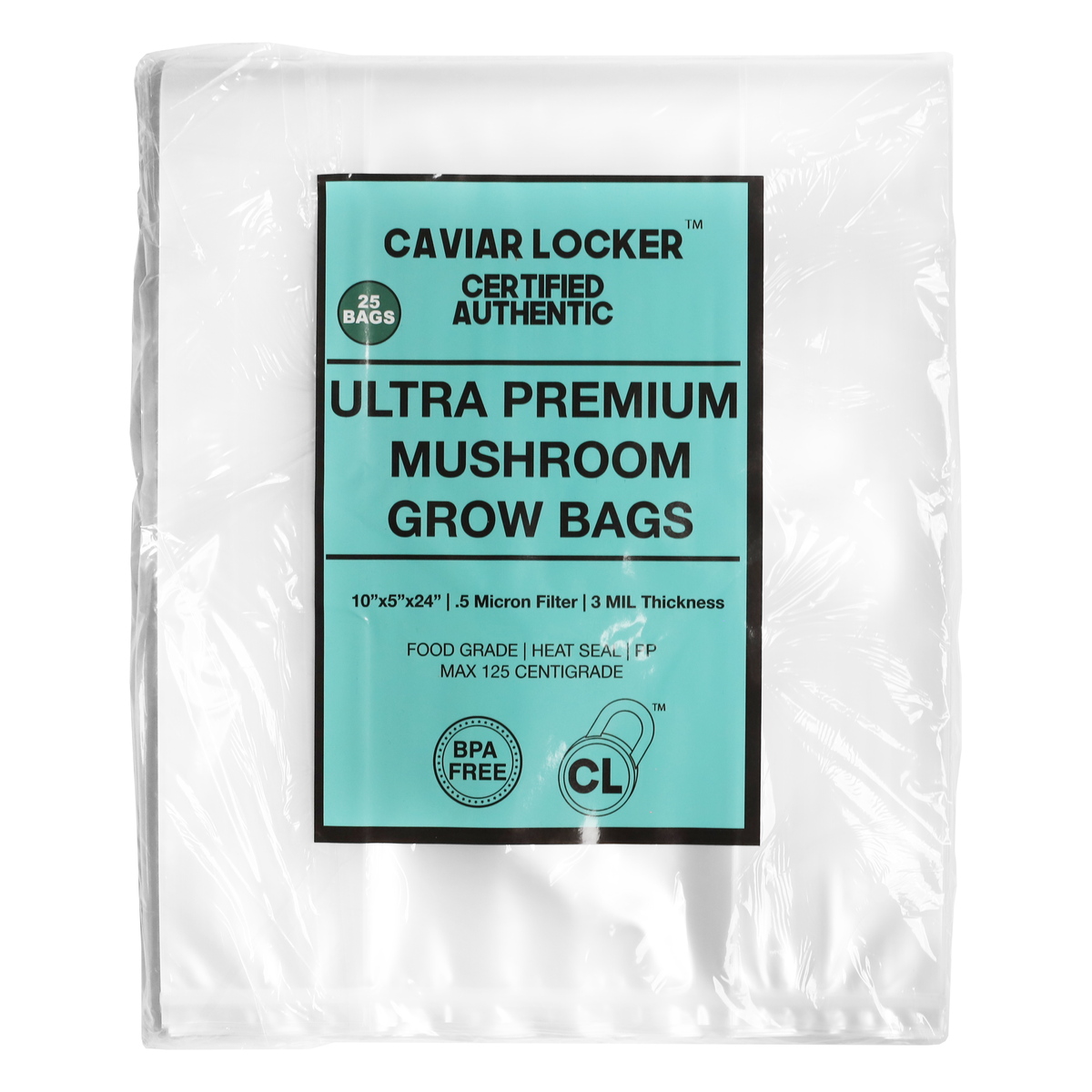
Wholesale Mushroom Grow Bags: How to Buy in Bulk Without Overpaying
If you're growing mushrooms at scale, grow bags are one of your biggest recurring costs. Get the specs wrong and you're fighting contamination all season. Get the supplier wrong and you're dealing with shipping delays, hidden fees, and bags that fail mid-run.
This guide breaks down exactly what to look for when buying mushroom grow bags wholesale — filter patch specs, bag thickness, sterilization compatibility, pricing benchmarks, and how to find a supplier worth reordering from.
Who Actually Needs to Buy Wholesale?
Home growers doing a few runs a year can get by with small packs. But if you fall into any of these buckets, buying in bulk makes sense:
- Semi-serious hobbyists running 10+ substrate blocks per year
- Commercial mushroom farms cycling multiple flushes at once
- Inoculant or substrate suppliers selling pre-filled bags to other growers
- Research labs and universities running repeated grain or agar work
The math is straightforward: per-bag cost drops significantly when you move from 10-packs to 100- or 500-packs. The key is knowing exactly which spec you need before you order in volume.
What Actually Matters in a Mushroom Grow Bag
Before you compare prices, know what you're comparing. There are four specs that determine whether a grow bag performs or fails.
1. Filter Patch Micron Rating
The filter patch is the breathable port on the bag that allows gas exchange while blocking contaminants. Micron rating tells you what it stops:
- 0.2 micron — blocks bacteria and most spores; best for contamination-prone environments or grain work
- 0.5 micron — the most common general-purpose rating; solid balance of breathability and protection
- 3–5 micron — high airflow; suited for fast-colonizing species like oysters that need more O2
Most growers default to 0.5 micron for substrate blocks. If you're getting unexplained contamination rates, go tighter. If colonization is sluggish on a fast species, go looser.
2. Bag Thickness (mil)
Thicker bags are more puncture-resistant and handle autoclaving without warping or losing their seal. The standard range:
- 2 mil — lightweight; fine for ambient-temp substrates and non-pressure setups
- 3 mil — the most common spec for pressure cooker and autoclave use; holds shape reliably
- 4–5 mil — heavy-duty; best for high-volume commercial sterilization cycles
If you're running bags through an autoclave at 15 PSI for 2+ hours, use at least 3 mil. Thin bags can develop micro-tears or poor top seals after sterilization — either of which can tank an entire batch.
3. Material and Seal Style
Standard grow bags are polypropylene (PP) — that's what can handle sterilization temperatures. Polyethylene (PE) bags will not survive an autoclave. If a listing doesn't specify PP, ask before ordering in bulk.
For seal style, look for:
- Pre-sealed bottom, open top — standard; you fill, inoculate, then heat-seal the top
- Gusseted bottom — stands up on its own, easier to fill without a second set of hands
- Self-healing injection port — optional but useful if you're not working under a laminar flow hood
4. Bag Dimensions
Grow bags come in a wide range of sizes. Here's a practical reference:
| Size | Typical Use |
|---|---|
| 6" × 10" | Small substrate blocks, single-species grain prep |
| 8" × 5" × 18" (gusseted) | Standard 3–5 lb substrate block — most common |
| 10" × 6" × 20" (gusseted) | Large 5–8 lb blocks, bulk oyster runs |
| 6" × 3.5" × 14" | Grain bags, inoculant prep, smaller runs |
For most commercial setups running 3–5 lb substrate blocks, the gusseted 8" bag at 3 mil with a 0.5 micron filter is the standard workhorse. Start there if you're unsure.
How to Compare Wholesale Suppliers Without Getting Burned
Price per bag matters. But it's not the only number on the invoice.
Watch These Hidden Costs
Shipping origin. Bags sourced from overseas can sit in transit for weeks — longer during holidays or port congestion. A quoted price of $0.18/bag becomes $0.30+ after air freight gets factored in. Domestic suppliers ship in days, not weeks.
Import tariffs. If your supplier manufactures overseas and imports to the US, tariff changes hit your cost basis mid-order or between reorders. That's a real supply chain risk. A supplier stocking inventory domestically eliminates that exposure entirely.
Minimum order quantities (MOQs). Some suppliers require 500 or 1,000 bags per order. That's fine for established farms. But if you're scaling up or testing a new spec, find a supplier with flexible MOQs or tiered pricing so you're not locked into over-buying before you've validated your process.
Sample policy. Any serious supplier should let you test product before you commit to hundreds of units. If they don't offer samples, that's a red flag worth noting.
What a Good Wholesale Supplier Looks Like
- Stocks domestically — ships from the USA, no customs delays
- Clear spec sheets: filter patch micron, mil thickness, bag material
- Tiered pricing that scales with quantity
- Responsive support for reorders and spec questions
- No tariff exposure baked into pricing
Pricing Benchmarks: What You Should Expect to Pay
Wholesale pricing varies by spec and volume. Here are rough benchmarks for standard 3 mil PP grow bags with 0.5 micron filter patches:
| Quantity | Typical Price Range |
|---|---|
| 10–50 bags | $0.50–$0.90 per bag |
| 100–250 bags | $0.30–$0.50 per bag |
| 500+ bags | $0.18–$0.30 per bag |
| 1,000+ bags | $0.12–$0.20 per bag |
If you're paying over $0.35/bag at 500+ unit quantities, you're either getting overcharged or absorbing excessive shipping costs. If you're seeing less than $0.12/bag, look closely at the specs — thinner material, inconsistent filter patch construction, and poor sealing are how some suppliers hit rock-bottom price points.
When to Lock in Bulk vs. Buy Flexible Quantities
Some suppliers sell by the case (typically 100–200 bags per case). Others let you order any quantity. If you're still dialing in your process — species selection, substrate ratio, sterilization time — flexibility matters more than per-unit savings.
Once you've validated your run and know what works, commit to larger quantities and take advantage of tiered pricing. The savings add up fast when you're going through 200–500 bags per month.
Don't over-buy before you've confirmed your setup. A contaminated batch at $0.15/bag is still money out the door — plus the substrate, the time, and the missed revenue from a failed flush.
Common Mistakes When Buying Grow Bags in Bulk
Buying on price alone. A bag that leaks, breathes poorly, or fails your autoclave cycle costs far more than the per-unit savings it promised.
Ignoring filter patch specs. A bag listed as a "mushroom grow bag" without a micron rating is not a bag you can trust for consistent results. Micron rating matters.
Ordering from overseas without accounting for lead time. If you need bags in two weeks, international freight won't work. Domestic suppliers ship in 2–5 business days.
Not testing before bulk ordering. Specs can vary between production batches. Run a few bags through your actual sterilization setup before committing to hundreds.
Over-ordering your first time with a new supplier. Lock in a trial quantity first. If the bags perform well and the service is reliable, then scale up your order.
Dragon Chewer Mushroom Grow Bags
At Dragon Chewer, we stock mushroom grow bags built for serious growers:
- Polypropylene construction — autoclave and pressure cooker safe
- Available in 0.2 and 0.5 micron filter patch options
- 3 mil standard thickness for sterilization durability
- Multiple sizes including standard substrate blocks and grain bag formats
- Flexible quantities — works for hobbyists and commercial farms alike
- Ships from the USA — no import delays, no tariff exposure
- Free shipping on qualifying orders
Whether you need 50 bags or 5,000, we've got pricing that scales with your volume and bags that perform across sterilization setups.
Browse mushroom grow bags at Dragon Chewer →
Try Before You Buy in Bulk
Not sure which bag size or filter patch spec is right for your operation? Request a free sample pack and test the bags on your actual substrate and sterilization cycle before you commit to a full order.
Request your free sample pack → dragonchewer.com/pages/sample-pack
Ships from the USA. Free shipping on qualifying orders. No tariffs on domestic shipments.