
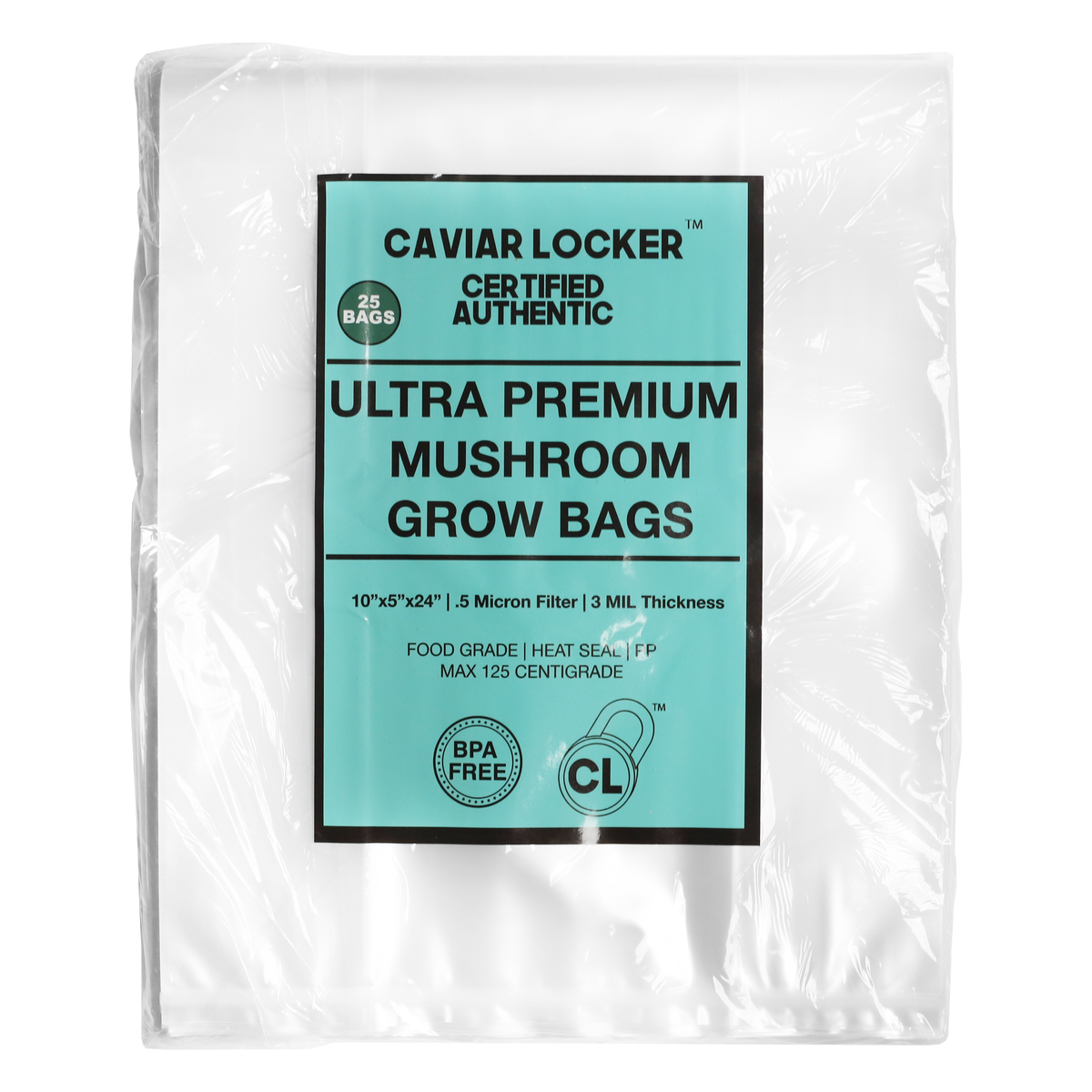
How to Choose the Right Mushroom Grow Bag: A Buyer's Guide
The bag you grow in isn't just a container — it's your contamination barrier, your gas exchange system, and your colonization environment all rolled into one piece of polypropylene. Get it wrong and you're throwing away substrate, time, and inoculation. Get it right and you're setting yourself up for clean, fast colonization and strong yields.
Here's everything you need to know to pick the right mushroom grow bags for your setup.
Why the Grow Bag Matters More Than You Think
A lot of growers obsess over their substrate recipe and inoculation technique, then grab whatever cheap bags are available. That's backwards. The bag determines whether your hard work survives to fruiting or gets wiped out by trich.
Three things the grow bag directly controls:
Contamination prevention. The bag creates a sealed environment that keeps mold spores, bacteria, and competing organisms out. A pinhole, a weak seal, or a filter patch that lets in the wrong particle size can cost you the whole batch.
Gas exchange. Mycelium needs oxygen. As it colonizes, it also produces CO₂. The filter patch manages that exchange. Too restrictive and you slow colonization. Too open and you invite contamination.
Colonization speed and yield. The right bag size, substrate volume, and breathability give mycelium the conditions to colonize fast and evenly — which translates directly to better yields when you flip to fruiting.
Types of Mushroom Grow Bags
Substrate Bags (Bulk Substrate Bags)
These are used for bulk substrate — usually sterilized sawdust, straw, coco coir, hardwood pellets, or a combination. They're used in the second stage of a grow, after you've got colonized grain to inoculate them with.
Substrate bags have larger filter patches to handle the increased gas exchange needs of a bigger volume of material. You're not injecting spores into these — you're opening them and mixing in colonized grain — so they don't always need a self-healing injection port.
Best for: oyster mushrooms, lion's mane, shiitake, reishi, and most gourmet species on hardwood-based substrates.
Grain Bags
Grain bags are used for sterilizing and inoculating grain — rye berries, wheat, oats, milo, or popcorn. Grain spawn is the engine of the grow: it gets colonized first, then used to inoculate bulk substrate.
Grain bags need tighter filter patches (typically 0.2 micron) because sterilized grain is a very attractive target for contamination. They also almost always have a self-healing injection port so you can inject liquid culture or spore solution without opening the bag.
Best for: producing spawn for any species. Most home growers work with grain bags in the 1–3 lb range.
All-in-One Bags (AIO Bags)
All-in-one bags combine grain and substrate in a single bag, separated by a filter or divider. You inject into the grain section, let it colonize, then break and shake to mix grain into the substrate layer — all without ever opening the bag.
AIOs are beginner-friendly because they eliminate the transfer step. The tradeoff is cost per unit and less flexibility in your substrate ratios.
Best for: newer growers, smaller home grows, and situations where minimizing contamination risk during transfers is the top priority.
Key Specs to Look For
Filter Patch Micron Rating
This is the most important spec on the bag. The filter patch allows gas exchange while blocking contamination. The micron rating determines what particle size can pass through.
- 0.2 micron: Use for sterilized grain bags. Tighter filtration, maximum contamination protection for high-nutrient substrates.
- 0.5 micron: Use for bulk substrate bags. Allows better airflow for larger substrate volumes where contamination risk is lower.
If you're buying bags without a micron rating listed, that's a red flag. You don't know what you're getting.
Bag Thickness
Measured in mils (thousandths of an inch). For mushroom grow bags:
- 3 mil: Lightweight, cheaper, fine for pasteurized substrate. Punctures more easily — not ideal for autoclave use.
- 4–5 mil: The sweet spot for most growers. Handles autoclave pressure, stands up to regular handling.
- 6 mil: Heavy duty. Used in commercial operations running high-volume autoclave cycles.
For any bag going in an autoclave, don't go below 4 mil.
Self-Healing Injection Port
A silicone port in the bag wall that allows you to inject liquid culture or spore solution with a syringe, then "heals" and reseals. Essential for grain bags. Optional but useful on all-in-one bags.
If you're working with liquid culture — and you should be if you're at all serious about your grows — you want a bag with a port.
Gusset / Flat Bottom
A gusseted bag has folds on the sides and a flat bottom, so it stands upright on its own. A flat bag is just that — flat.
For colonization, upright bags are more practical: substrate settles evenly, there's no pressure on one side, and you can shake them without acrobatics. For most setups, buy gusseted bags.
Autoclave-Safe vs. Oven-Safe
Non-negotiable: if you're pressure cooking or autoclaving your substrate, you need polypropylene (PP) bags rated for autoclave use — typically 121°C (250°F) for 60–90 minutes under steam pressure.
Oven-safe bags and autoclave-safe bags are not the same thing. Dry oven heat behaves differently from autoclave steam pressure. Make sure the bags you buy are rated for the sterilization method you use.
Size Guide
Small (1–2 lb capacity)
Grain bags for small-batch spawn production. All-in-one bags for single-flush home grows. Good for: testing new genetics, beginner grows, and low-volume operations where you want to keep batch numbers manageable.
Medium (3–5 lb capacity)
Grain bags for producing spawn in meaningful volume. Substrate bags for gourmet species like oyster and lion's mane. Good for: serious home growers, micro-farms producing for farmers markets or direct-to-consumer.
Large (5–10 lb+)
Bulk substrate bags for commercial production. High-volume grain bags for commercial spawn operations. Good for: commercial farms, scaled production runs, and any operation where per-unit cost per flush matters.
When in doubt, go medium. Most home growers underestimate how much volume they actually need and end up wishing they'd bought bigger bags.
Buying in Bulk: What to Look For
If you're running more than a few bags a week, you need a wholesale supplier — not a retail marketplace with inflated per-unit pricing.
Here's what matters when evaluating a wholesale grow bag supplier:
Minimum order quantities (MOQ). A good supplier has MOQs that match how you actually operate. Ask upfront. If MOQs are too high for where you are now, find a supplier that scales with you as your operation grows.
Consistent specs. The biggest hidden risk with cheap bulk bags is batch inconsistency — filter patch sizes that vary, seals that aren't uniform, bag thickness that changes between orders. Buy from a supplier that can tell you exactly what's in the bag and hold to those specs across every shipment.
Autoclave certification. If the supplier can't tell you the temperature rating of their bags, don't buy them for autoclaving. Vague specs are a liability in a production environment.
Shipping from domestic warehouses. Bags sourced from overseas can mean long lead times and unpredictable quality variation. A domestic supplier ships faster, carries more consistent stock, and doesn't introduce tariff risk into your supply chain.
Sample availability. Any legitimate wholesale supplier should be willing to send samples before you commit to a large order. If they won't, that tells you something about how they operate.
Ready to Stock Up?
Dragon Chewer carries mushroom grow bags built for serious growers — the right specs, consistent quality, and wholesale pricing that makes sense at any scale. We ship from Lancaster, CA and Oklahoma City, OK — free shipping on eligible orders, no tariffs.
Browse our Mushroom Grow Supplies →
Want to try before you buy? Request a free sample or reach out to our team:
- 📞 661-206-7134
- 📧 sales@dragonchewer.com
- Monday–Friday, 8am–4:30pm PST